Affluent women force rethink of legacy planning in Asia-Pacific
Stable growth and early engagement shift advice beyond transactional transfers.
Insurers and advisors in the Asia‑Pacific region should rethink legacy planning as affluent women gain control of assets and redefine succession around stable growth and long‑term governance, analysts said.
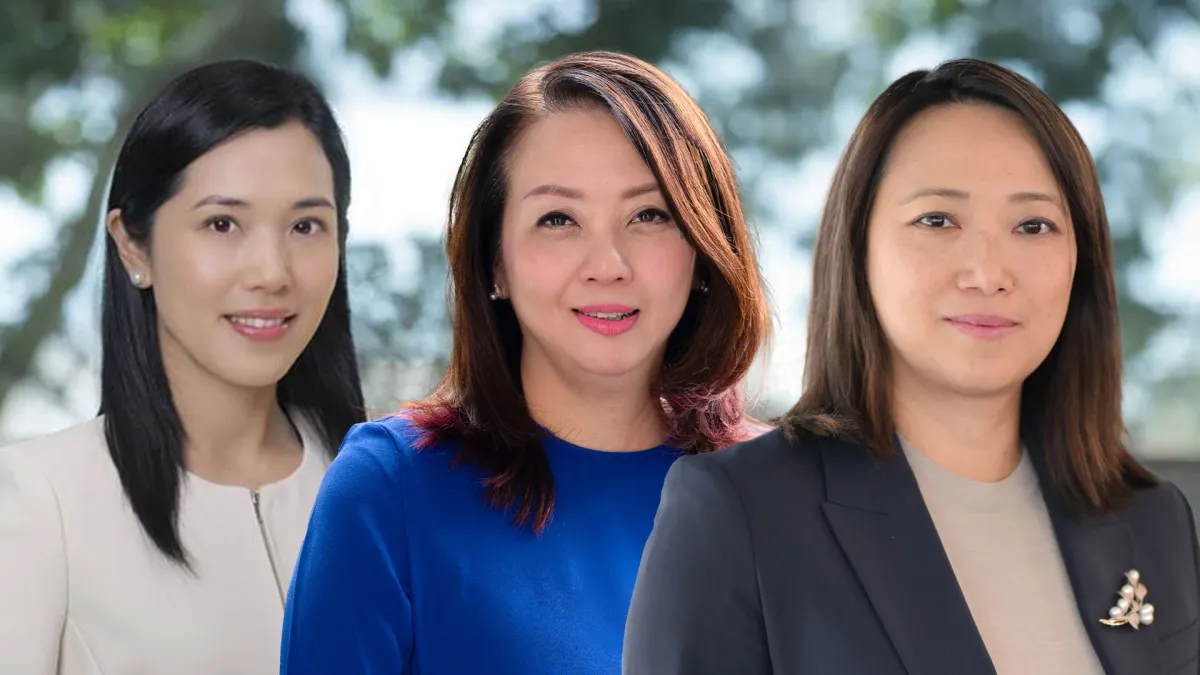
“Women now hold a third of the world’s wealth, with 40% concentrated in Asia, and their influence over how that wealth is governed is growing steadily,” Louise Thean, chief proposition officer at Grandtag Financial Consultancy (Singapore) Pte. Ltd., told Insurance Asia.
Thean said women are increasingly involved in, and often driving, decisions on ownership, succession, and long‑term purpose, shifting legacy planning away from one‑off transfers towards a stewardship process.
Alison Law, global chief distribution and customer officer for insurance at HSBC Insurance (Asia-Pacific) Holdings Ltd., said that shift is shaping investment choices.
“Their legacy planning goals show a greater focus on stable growth and maximum value, whilst capital preservation remains an equal priority,” Law said in an emailed reply to questions.
Ada Kung, chief investment strategist at Sun Life Asset Management (HK) Limited, said these priorities reflect how women approach financial decision-making more broadly.
“Decisions around healthcare, education, family support and future security are often considered collectively rather than in isolation,” Kung said, adding that this drives a preference for financial planning built around resilience and consistency rather than short-term gains.
Data from HSBC Insurance showed 54% of women prioritise stable growth, compared with 49% of men, whilst 49% focus on maximising value, against 45% for men. About 44% of Asian women cited macroeconomic conditions as the main trigger for starting legacy planning.
The change is exposing gaps in advisory models that remain centred on products rather than client intent.
Thean said traditional frameworks often miss the issues women raise around governance, family alignment, and long‑term objectives.
“Many wealth managers still lead with product and performance, when the questions women raise go further,” Law said in a separate email.
Kung said the disconnect is structural rather than behavioural.
“The gap between financial leadership and professional advice is therefore not driven by a lack of confidence or capability, but by whether existing advice models align with how women manage money in practice,” she said.
She added that trust and accessibility remain barriers, noting that “around two-thirds of women view the industry as male-dominated,” which continues to affect engagement with advisors, referring to Sun Life’s latest Women’s Wealth survey.
Planning decisions are also influencing where women choose to structure wealth. HSBC data showed 92% of women are using or considering offshore financial centres, with Singapore, the US, and Hong Kong amongst the most favoured locations.
Law said the preference reflects a focus on efficiency and tax optimisation. Insurance is gaining prominence in that context.
Law noted that insurance could support capital preservation and stable growth whilst offering flexibility for tax planning and diversification.
Women place slightly more importance than men on superior products and tax efficiency, suggesting increasing investment sophistication, according to HSBC.
Structured solutions including indexed universal life policies are being incorporated into broader governance frameworks, Thean said. These structures combine market‑linked growth with downside protection, making them suitable for intergenerational planning.
Timing is also shifting. All women aged 30 to 39 are already engaged in legacy planning, compared with 86% of men in the same age group, based on HSBC data. Law said this calls for earlier, education‑led engagement rather than advice concentrated around liquidity events.
Kung said earlier engagement is critical not just for accumulation but for systemic resilience.
“When a significant portion of the workforce reaches retirement with insufficient personal savings, the impact extends well beyond individual households,” Kung added, citing rising pressure on retirement systems and healthcare infrastructure across the region.
For insurers and advisors, adapting means building relationships across life stages and aligning advice with how women define control, continuity, and purpose in managing wealth.




















 Read Here
 Advertise
 Sign Up